Research Projects.

Reactor-Network Modeling

High-fidelity computational fluid dynamics can provide detailed insight into a combustor, but its computational expense limits its use in rapid design studies. Reactor-network modeling offers a promising reduced-order alternative.

Existing reactor networks are formulated for gaseous fuels, which limits their applicability to reactors where fuel is introduced into the combustor in the liquid phase. Our group is developing techniques that incorporate liquid-fuel spray dynamics—including breakup, droplet heating, evaporation, and mixing—directly into reactor-network construction.

The animation compares lean-blowout behavior predicted by a liquid-fueled reactor network with a large-eddy simulation. In our validation study, the reactor network reduced computational cost by more than 7,800 times, captured the correct lean-blowout trend, and matched the baseline blowout equivalence ratio within 0.46%.
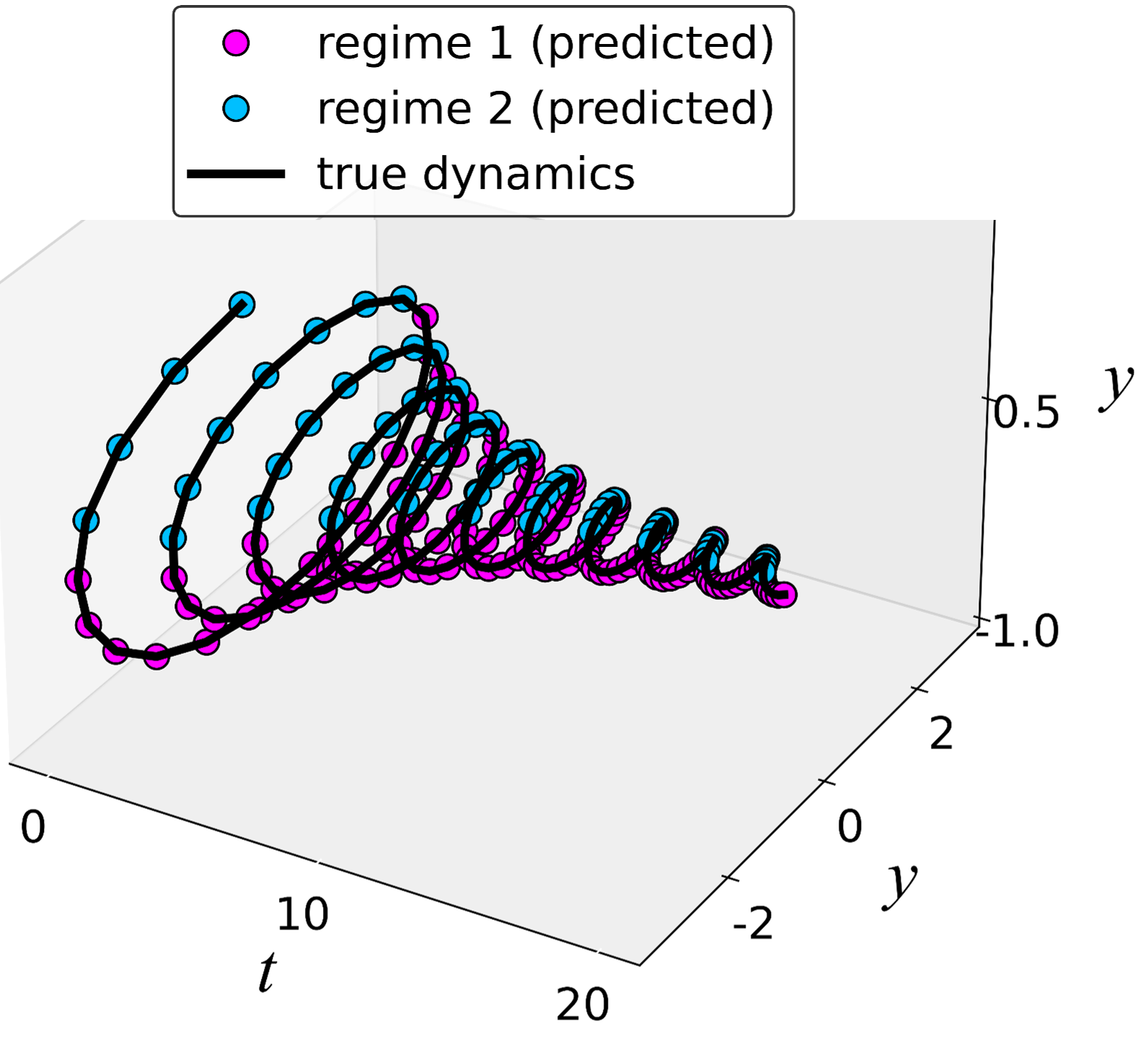
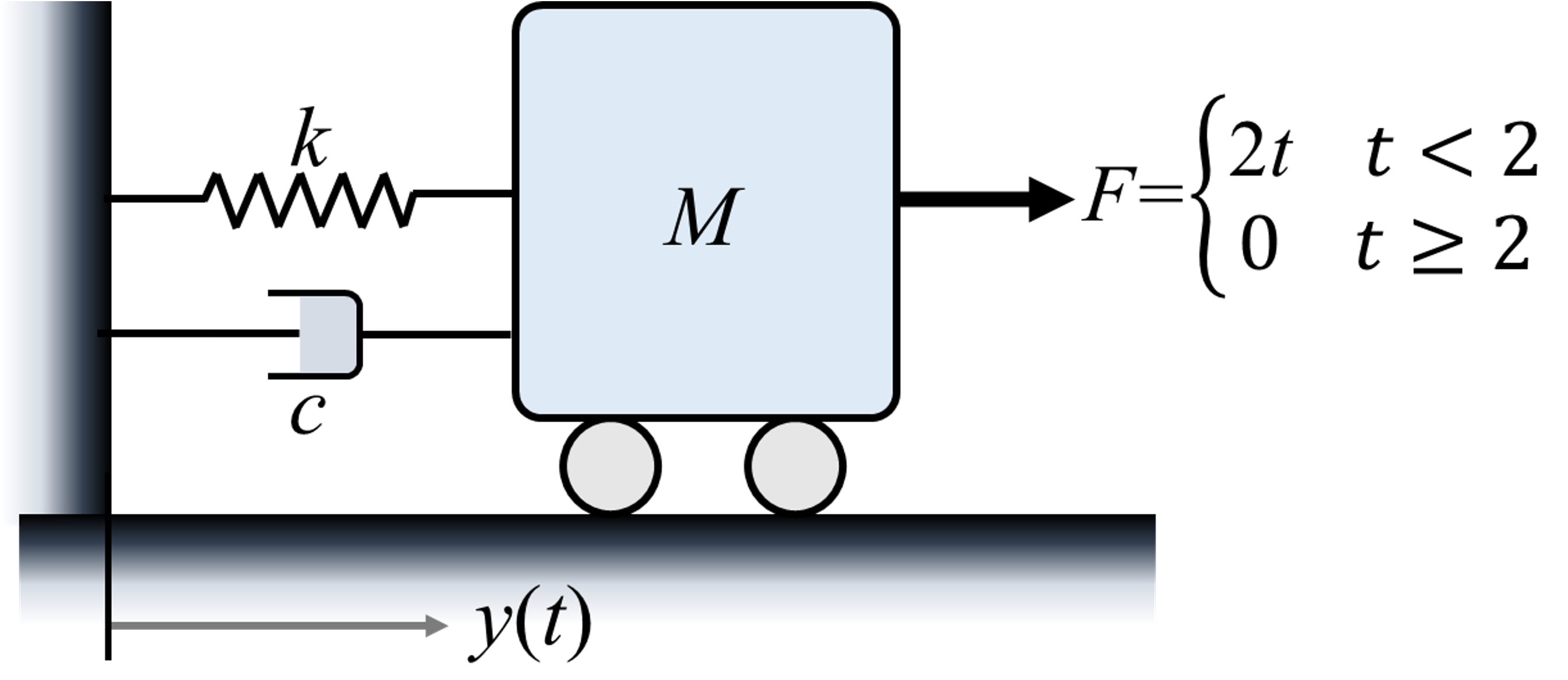
Predicted and true dynamics for a spring-mass-damper system with two functional regimes Spring-mass-damper system subjected to a changing external force

Scientific Machine Learning

Our group develops scientific machine-learning methods for problems in which accuracy, physical consistency, and behavior during time evolution matter as much as fitting the available data.

One direction uses solver-in-the-loop learning. Instead of training a model only against instantaneous targets, the numerical solver is embedded in the learning process so the model is judged by the trajectory it produces. We have applied this idea to reduce chemical mechanisms and to learn fully data-driven models for chemical evolution.

We also develop techniques that embed physical laws into learned dynamics. For reacting systems, this includes constraining chemical evolution to remain thermodynamically admissible and satisfy the second law of thermodynamics.

A third direction is the development of specialized models for systems that undergo regime changes. Rather than fitting one global model across incompatible behaviors, these methods learn multiple local models together with the rules governing how the system switches between them. For example, in right figure, a competitive leanring approach is used to obtain distinct functional regimes in a spring-mass-damper system: it correctly indentifying the governing equation in each regime and the correct switching behavior.

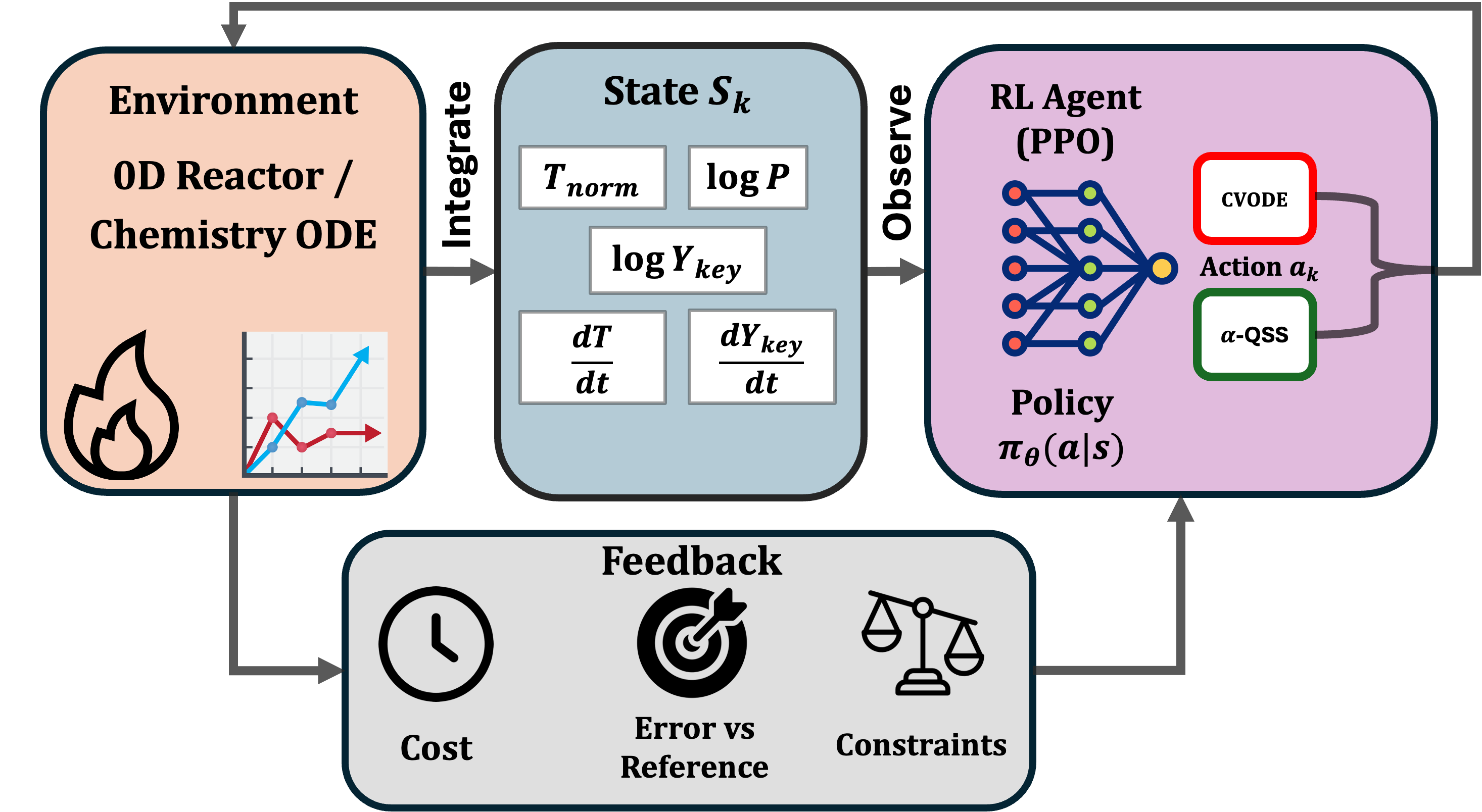
Reinforcement-learning framework for choosing between stiff and non-stiff chemical-kinetics solvers

Reinforcement Learning as a Decision Layer

Supervised learning learns from labeled examples. Reinforcement learning instead learns from experience: an agent observes a state, takes an action, receives a reward, and improves its decisions through repeated interaction with an environment.

Our group develops techniques for embedding reinforcement-learning agents within scientific simulation tools. The agent does not replace the underlying physics; it serves as an autonomous decision layer that adapts how the simulation is organized or solved.

In reactor-network modeling, an agent can refine decisions about how a high-fidelity flow field is divided into reactor zones so that the resulting network better predicts a target quantity such as lean blowout. In detailed combustion simulations, an agent can choose among numerical solvers as stiffness and local thermochemical conditions change.

The schematic shows an agent trained to select between a robust implicit solver and a faster quasi-steady-state solver during chemical-kinetics integration. The learned policy achieved an average speedup of 4.65 times in homogeneous-reactor tests and transferred to counterflow flames with speedups of 4.5–5.8 times while maintaining temperature errors below 9 K.

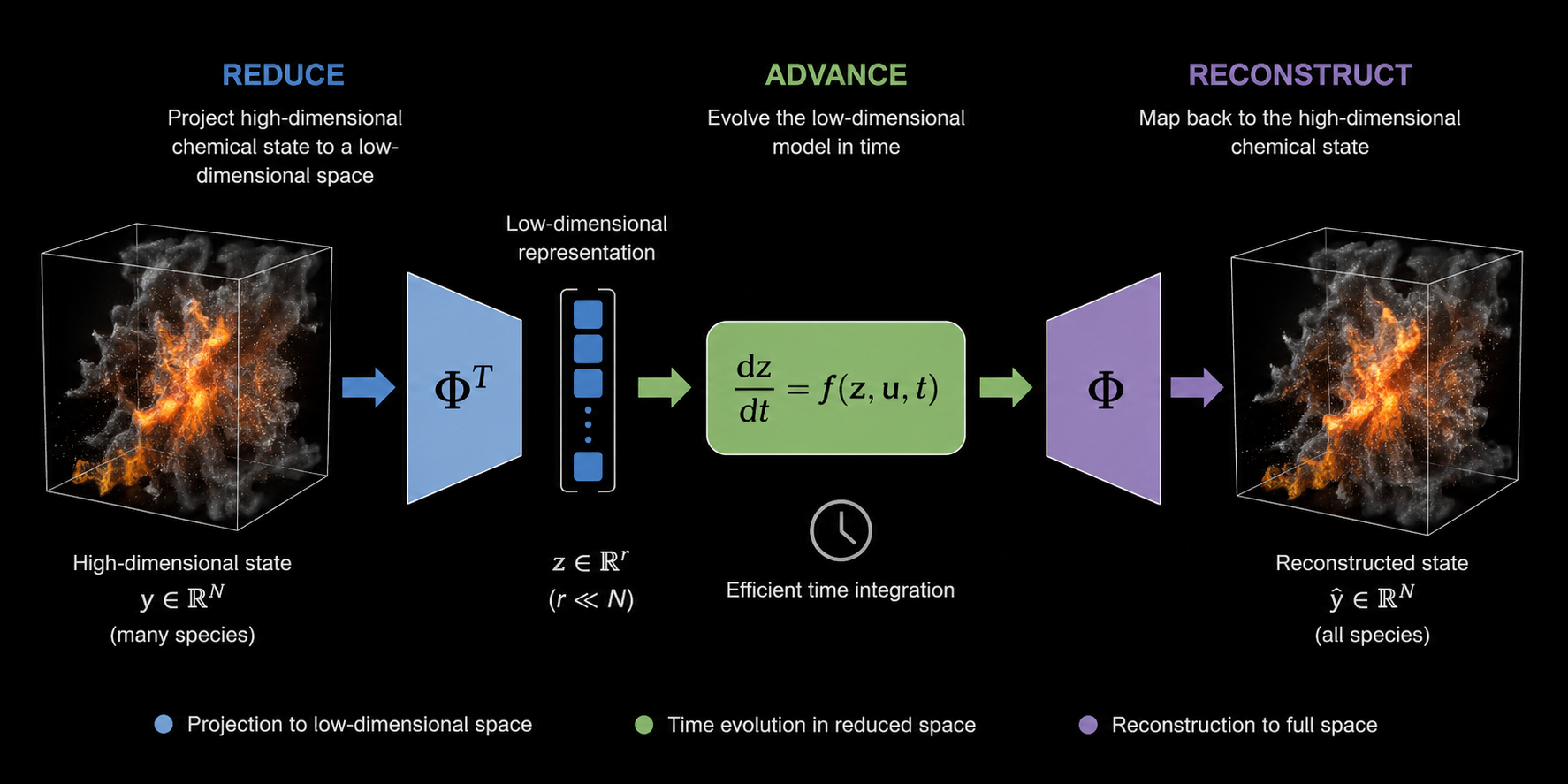
High-dimensional reacting-flow state represented with a compact set of reduced coordinates Data-driven replacement of a high-dimensional flamelet manifold for reacting-flow simulation

Compact Representations of Reacting Flows

Turbulent-combustion simulations are expensive in part because they must evolve a large number of interacting chemical species and energy variables over a wide range of spatial and temporal scales. Reduced-order approaches replace this full description with a smaller set of coordinates. These coordinates may come from physics-based manifolds or be discovered directly from simulation data. Our group develops methods in both settings.

Flamelet models, for example, precompute chemistry and retrieve it during a flow simulation. Their memory requirements grow rapidly with the number of control variables, i.e., the familiar curse of dimensionality. We develop data-driven closures that replace high-dimensional tables and predict species mass fractions and progress variable source terms directly from compact control variables.

We also develop projection-based models using principal component analysis and linear autoencoders. These methods identify a compact latent representation of the thermochemical state, transport only the dominant coordinates, and reconstruct the the full state at the final time step. Our work focuses on making these representations accurate during coupled evolution, scalable to multidimensional flows, and reliable beyond the data used to construct them.

Reinforcement Learning for Simulation-Driven Design

Simulation-driven design can reveal high-performing engineering configurations, but every evaluation may require an expensive computational model. The central goal of this work is to learn search strategies that reach useful designs with fewer simulation calls.

Population-based methods such as particle swarm optimization, ant colony optimization, and artificial bee colony algorithms are well suited to nonlinear, multimodal, and non-differentiable design spaces. Multiple agents explore different regions and exchange information, balancing broad exploration with refinement of promising solutions.

In conventional swarm algorithms, the rules governing motion, attraction, communication, and exploration are specified manually. We instead use reinforcement learning as a meta-optimization framework: agents gain experience across optimization landscapes and learn how to cooperate while searching for minima or maxima.

The resulting policy can serve as the decision-making layer around a simulation, directing where the design space should be sampled next. Our aim is to develop learned swarm behavior that uses limited computational budgets efficiently and accelerates optimization of complex energy systems and engineering processes.

View our complete list of journal articles.

View Publications